Showing posts with label Classics revisited. Show all posts

11.02.2019

Vintage recipe test: Peanut Butter Bread

From my Oma's collection comes my copy of The Settlement Cook Book (the main title is actually The Way to a Man's Heart), given to her on Christmas 1945 from her dear friend Mamie. There were a number of settlement houses in the 19th and 20th centuries, one of the best-known being Chicago's Hull House. The Settlement House of this cookbook was a charitable organization that helped women in need and Jewish immigrants.

The author, Lizzie Black Kander, was a social worker there who was tasked with instructing these women how to be homemakers in America, and this cookbook was her answer. So although it's a cookbook, it's also a manual of sorts instructing women how to set a proper table, drain dishes, polish silver, pick up broken glass, and store milk. I'm sure my edition was updated for a 1945 kitchen, reflecting ingredients and conveniences that arrived after its original publication. Proceeds of the book benefited the house, and it was reportedly the most successful fundraiser of its kind. More than 40 editions have been printed since its first first sold-out printing in 1901, last revised at some point in the 1990s. My copy is the 27th edition.
Opening this book feels like opening a sort of treasure or time capsule. Each delicate page can contain as many as five recipes, sparsely described, often referring to a recipe on another page.  There are no food illustrations - we're used to that with vintage recipes - but there are occasional darling illustrations of children happily doing things: rolling pie dough, fishing, collecting eggs.

My maiden baking voyage from this book was peanut butter bread. As soon as I saw the recipe, I marveled at the fact that peanut butter bread isn't really a thing in modern the quick-bread world, for as much as the modern world loves peanut butter. It's hard to find recipes for it on the internet, where I found it described as Depression-era food.

Other than the peanut butter, there is no fat in this recipe, unless you count the milk (whole milk would have been best, but I only had 1%). I had to make my best guess as to what kind of peanut butter I should use, i.e., was the peanut butter of this era more like Adam's natural peanut butter, the kind you have to stir, or was it common yet to find homogenized peanut butter which is most common today? After some "history of peanut butter" Google searches I felt OK about using the no-stir variety (homogenized was common in the 1930s) from Adam's, which has no sugar.

I also wondered about baking powder, since that has changed with time as well with double-acting varieties being the norm in most kitchens. This recipe called for four teaspoons which seemed like a lot. I used the full four teaspoons and nothing crazy happened.

Making it, it is everything a quick bread should be: it comes together in the time it takes to heat the oven, especially with a Kitchenaid mixer. The batter is like that of bland peanut butter cookie dough. I took the liberty of sprinkling turbinado sugar across the top after pouring it in the pan.

So how did it taste? Fine, not remarkable. Like something you'd serve and eat with other things, but probably not something you'd eat, rave about and ask for the recipe. But it was a little more special than mere sustenance. Mrs. Kander advised waiting a day before eating it, which we did, so we'll never know the difference of tasting it fresh out of the oven. My parents were with us the morning of the inaugural slices, and it was a nice accompaniment with coffee and eggs, topped with salted butter, or strawberry jam, or Nutella, the latter of which I enjoyed that evening for dessert (sliced bananas atop the Nutella would have been even better). After day six, only the heel remained and it was so dried out and crumbly,  it was almost like eating a peanut butter cookie. We still ate it and didn't mind.
Appropriately eaten from one of Oma's plates

I don't need to make it again, though it was enjoyable to eat. As Mamie wished for my Oma in her inscription, I'd consider this experience a happy recipe try-out.

Try it for yourself, and maybe add in some chocolate chips, or cinnamon, or both. Or make a yummy glaze: chocolate, strawberry or simple sugar.

Peanut Butter Bread
adapted from The Settlement Cook Book

2 c. flour
4 tsp. baking powder
1 tsp. salt
1/4 c. sugar
2/3 c. peanut butter (I used Adam's No-Stir crunchy)
1 1/4 c. whole milk
2 T. turbinado sugar, for topping

Grease a standard loaf pan well with shortening, butter, or other greasy thing of your choice. Heat the oven to 350 degrees.

In the bowl of your mixer, sift together the dry ingredients. Add the peanut butter and milk and beat at low speed to prevent milk splashing, then increase to medium speed until thoroughly mixed. Pour into the loaf pan, sprinkle with the turbinado sugar, and bake 45-50 minutes, or until the bread is golden and a toothpick comes out clean-ish (a few moist crumbs are okay). Let the bread cool in the pan for a few minutes on a cooling rack, then turn out of the pan to cool completely.

Eat it the first day. I dare you. Or follow Mrs. Kander's suggestion and eat it a day later.

10.16.2019

Vintage recipe test: Curried Scrambled Eggs, Beurre Noir


Let's just cut to the chase: this was so good. How it's taken me this long to put curry powder in my scrambled eggs is a mystery. With chopped onion and bell pepper, plus bacon, it's a winning formula.

But the beurre noir! This was a revelation. When browned butter is drizzled over these eggs, it takes the flavors to new heights. The hint of sweetness from the caramelized milk solids is reminiscent of getting a little maple syrup from your stack of pancakes on your eggs, but more appropriate.

Bless you, Chef E.G. Stockton from La Jolla, California, for revealing this amazing Sunday morning breakfast to us.

"Your eyes will sparkle after your first mouthful of Chef Stockton's concoction, but if your palate craves more mild treatment, a slight pinch or even a few grains of curry powder will suffice," it says. No, incorrect. Do this recipe as written.

A truth: "When accompanied by hot biscuits [or an English muffin] and strawberry preserves [or huckleberry jam], this makes a breakfast long to be remembered!"

Curried Scrambled Eggs, Beurre Noir
adapted from Cooking Bold and Fearless

6 eggs
1 tsp. curry powder
1/2 tsp. salt
6 T. cream (or milk)
4 slices bacon
1 small onion, minced
1/2 green (or red) bell pepper, minced
1/4 c. butter
My 2019 addition: a few fresh cilantro leaves, for garnish

1. Fry the bacon until crisp. Drain on paper towels and set aside. When cool, chop fine. Discard excess grease but leave about 2 tsp. in the pan for frying the veggies and eggs.

2. While the bacon is frying, beat eggs until light. Dissolve curry powder and salt in milk/cream, and add to beaten eggs.

3.  With the heat now on medium, using the greasy bacon pan, fry the pepper and onion until tender and delicately browned. Add the egg and chopped bacon and reduce the heat to low. Scramble with as little stirring as possible.

4. Meanwhile, place butter in a small saucepan over medium heat. Let it melt, bubble, pop, subside and brown. It will smell nutty and heavenly. Remove from the heat and place in a bowl so as not to continue browning/blackening.

5. When the eggs are cooked to your liking, plate and drizzle a small amount of brown butter over the scramble. Top with cilantro. Serve with your biscuits and jam.


10.14.2019

Vintage recipe test: Good Neighbor Cake


This recipe comes to you from Cooking Bold and Fearless, a 1957 Sunset Magazine publication that features recipes from "Chefs-of-the-West," predominantly male, as far as I can tell.


The Good Neighbor Cake recipe is signed by Fred Nehsmann, a writer in Lemon Grove, Calif. I tried looking him up on the internet to no avail, so I'm not sure of his credentials and why he was deemed worthy of inclusion in the "Chefs-of-the-West" group. 

A neighborhood block party provided the perfect occasion to try this out. I know it's never a good idea to test out a new recipe on guests or party-goers, but I put a lot of faith in the title. I've always loved the idea of baking something to take to a neighbor, but have been too shy to do so, so a block party provided a way to quietly set something on a table and let people try it, no pressure. I also loved the seasonal ingredient of apple at an October gathering.


The Good Neighbor Cake a basic layer cake with orange zest, and the frosting is made with egg whites and sugar, studded with apple. Otherwise, nothing terribly fancy.


While it turned out fine, a few modifications along the way probably made it better than as written, and had I been more of an expert in making layer cakes, I probably would have realized sooner that caster sugar is better for cakes and frosting, and that I overwhipped my egg whites for the batter. 


The cakes also sunk quite a bit, and I wonder if that was because of the egg whites, or because I forgot to turn on the oven ahead of time, so the pans with the batter were sitting out longer before going in the oven.


The simple frosting called for freshly grated apple, and I worried that the apple would cause the mixture to separate due to wetness, or make the cake soggy. I elected to squeeze out as much juice as possible before adding it to the frosting, and while it was still kind of a sloppy frosting, it held up okay on a cool evening (the juice was also very tasty on its own!). But I wish I'd used powdered sugar because you could feel the grit on your teeth.

Also, how do we feel about eating uncooked egg whites? I'm OK with it, but it's one of those things I probably wouldn't tell people before they eat it... that's the kind of Good Neighbor I am.


Here's the original recipe:


And my version:

Good Neighbor Cake
Adapted from Cooking Bold and Fearless

Ingredients
1/2 c. butter, room temperature
1 1/2 c. sugar
Zest of one large orange
4 eggs
2 c. sifted cake flour (i.e., sift the flour before you measure it)
4 tsp. baking powder
1/4 tsp. salt
1 c. whole milk

For frosting:
One Granny Smith apple
1 c. powdered sugar or fine/caster sugar (or just blitz regular sugar in the food processor for a few seconds)
2 of the egg whites from the four eggs above

Make the cake
1. Heat the oven to 350. Grease and flour two cake pans.

2. Separate the eggs: using three bowls, place all four yolks in one bowl, and two egg whites in another, and the remaining two in the third bowl (this will be used for the frosting - place these in the fridge until needed). 

3. Sift the flour with the baking powder and salt and set aside.

4. Cream butter and sugar together until light, about 5 minutes on medium speed. Add the orange zest.

5. Beat in egg yolks, one at a time, mixing thoroughly after each addition, scraping down the bowl as necessary. 

6. Alternate adding portions of the flour mixture with the milk, beating until smooth, several rounds. 

7. In a separate bowl, beat the two egg whites until stiff peaks form, but not dry (I overbeat these, I think, which might have caused my cakes to sink). Fold gently into batter until there are no white streaks.

8. Pour batter evenly between the prepared cake pans. Bake 25-30 minutes, until tops are springy and lightly browned. Remove from pans and completely cool on a rack.

Make frosting

1. Peel and grate the apple.

2. Beat the remaining 2 egg whites until stiff, then gradually beat in a cup of powdered sugar (I used regular sugar but found the texture rather grainy; I think powdered or at least caster sugar would have worked out better).

3. Squeeze excess juice from the apple and beat into the frosting. Frost the cooled cakes and layer together. Keep cool in the fridge until serving.


10.12.2019

Cooking Bold and Fearless

Thanks for reading/caring about/sympathizing with my Joy of Cooking post last week. I'm really just scratching the surface of a much larger issue pertaining to mental load and traditional gender roles. I talk about this stuff all the time with my girlfriends, but I should also make it clear that I have it good - like, really good. I have been societally trained to worry about the stuff I worry about, but I have a partner who shares these household tasks more equally than a lot of men I know. On some weeks, I'm pretty sure it's lopsided toward him doing more of the work. More than that, he doesn't make a big deal out of it. I'm trying to take on his chill attitude and not take it for granted.

Coincidentally, a couple days after my blog post, this essay came out: It's So Much More Than Cooking. It captures the sentiment I was feeling at the time, and it continued to resonate with my own questions of Why do women care about this stuff so much? Can change happen if we stop caring about the stuff we're trained to care about? Is that OK? We each have to decide what that looks like. I did have an interesting moment last week when I personally experienced what I've teased Joel about for years in having "fridge eyes," i.e., not knowing that we had a particular ingredient in the fridge - "If you'd only look, you'd see it," I'd say in a very smarty-pants way. Turns out, when you don't buy the groceries, fridge eyes is real. 

Also, I had a delightful moment last weekend when I had the opportunity to make myself a baked potato and Joel had a burrito. We ate our respective dinners together on the couch while we watched a movie and it was bliss, I tell you. 

All this is to say I'm temporarily excited about a new cooking project I'm planning to undertake this fall. I started this blog to highlight ways to breathe new life into old things, and this project does exactly that: I'm taking old cookbooks I've collected over the years and am testing their recipes. I'm talking about ones that may call for MSG (which is actually gaining a resurgence among chefs) or chipped beef or gelatin, perhaps all three! I'm not sure where I'll find chipped beef or MSG in Spokane. No matter, I'm excited to experiment and see what can be attractive and delicious at the 21st century table, and what else I can learn. Most of these recipes don't have photos or detailed directions, so I view this as low pressure, starting with an attitude of "this might not taste good, but let's just see." I'll just make sure there's back-up frozen pizzas or canned soup at the ready for when a main dish is inedible.

Like these "cheese carrots" I made a few years ago.


Let the fun begin.

8.08.2019

From the summer kitchen

With the deck project having taken away crucial barbecuing space this summer, and with the milder temperatures not preventing me from turning on the oven, it's been a slightly different kind of summer table spread. Here are the things I remembered to document:

For breakfast...


Dutch babies. I experimented with a couple different recipes, including a gluten-free variety, to get the perfect baby for all. These were a special request for Joel's dad's birthday breakfast.  Pictured here was the first try, and my favorite basic recipe from a 1974 Scandinavian cookbook from Sunset magazine (thanks, Mom!), baked in a cake pan. It has a little lemon zest and cardamom in the batter, which is simply nice. I mean, it's really hard to screw these up. But they always feel special.


Buttermilk sandwich bread...which I used for croque madames...in honor of the final stage of the Tour de France, which as I might have mentioned before, I won. 


Blueberry scones. Made on a slightly hungover Sunday morning after a night out with my gal pals, who sent me home on my bike with a pint of freshly picked blueberries in my pannier. I used a recipe for whole-wheat buttermilk scones that called for raisins, which I subbed with the berries. The scones were a tad dry (whole wheat flour AND oatmeal) so the berries added a nice burst of juice and flavor.


Baked banana buttermilk donuts. My local kitchen supply store had a sale during the 4th of July on all products that were made in the U.S.A., which included a donut pan I've lusted after for years, so I took it as a sign and bought it. Thanks, America. Because I had buttermilk and overripe bananas, I looked online to see how to combine it into donuts. We topped these with Nutella. It tasted more like a muffin. But donut shaped.

(If you can't tell, I seem to have a lot of buttermilk to deal with.)

For dinner:


Roasted dill salmon. Dill doesn't often get its day in our house, but I had a real craving for it and this recipe from the New York Times was quick and delicious. You simply make a marinade of 1/4 c. lime juice, 2 T. olive oil, 2 T. soy sauce, 2 T. maple syrup, 3 T. chopped fresh dill, 1/4 tsp. turmeric and a pinch of saffron (if you have it - I didn't), and a crushed garlic clove. Place salmon fillets skin side down on a lined rimmed baking sheet (smaller is better), season with salt and pepper, and pour the marinade over and let it sit for about 15 minutes as the oven heats to 425. Then transfer it to the oven for about 10 minutes and serve with rice or whatever. 


Sesame soba noodle salad with roasted mushrooms and tofu. It's probably one of my favorite meals and I don't make it often enough. It's so savory, crunchy (that's cucumber in there...not avocado) and satisfying and I'm always glad to have leftovers for lunch. The recipe comes from Melissa Clark's Cook This Now...like so many recipes I post on this blog.


Soupe au pistou. I held onto this recipe from my Milk Street mag a couple months back for pesto season. It's weird because you'd think the last thing you'd want to make in summer is soup, but this celebrates all its flavors and it was so, so good. Fresh tomatoes, green beans, carrots, beans, garlic and small pasta go into the soup, and the pesto is added as a garnish. It's nice to have a partner who works from home and can prep this on a weekday afternoon and tend to it as needed (cooked from dried beans), otherwise this would have definitely been a weekend meal. 


Chicken Milanese with tomato, mozzarella and basil salad. Because after a long day, it feels good to take a meat pounder to some chicken cutlets. The basil dressing that goes with this is divine. Another gift from Melissa Clark via the New York Times.

Chicken tinga tacos. This is something Joel makes and it's one of my forever favorites. I don't care about other recipes for chicken tacos or burritos anymore. I contribute the pickled onions and a side of Rancho Gordo beans. 

For dessert:


Smoked paprika peanut butter cookies. I got the recipe from David Lebovitz's blog and was totally starstruck (in the nerdiest of ways) when he shared my post on Instagram and used it as an opportunity to link to the recipe again. To be honest, I was expecting more smoke, but ultimately these were just strangely colored but very delicious, chewy peanut butter cookies. 


S'mores blondies. If these aren't viral on the internet yet, they will be. Gooey as all get-out. I took to calling them power bars. 

6.11.2018

Mom's Slow Cooked Pepper Steak (instantly!)

Sometimes I look back on old blog posts from years and years ago and try to recall the energy with which I used to approach cooking. Lately I am kind of bored with it and am forcing myself to branch out by buying ingredients without a plan. What should I do with a bundle of spring onions? (I'm still trying to decide. Meanwhile, they wilt in the fridge.) What can I do with tater tots and marinated artichoke hearts? (Eat separately, do not mix.) And didn't I once read a recipe that called for black sesame seeds, because I'm finally seeing them in the store! (Recipe still not found.) Ugh, I am a mess.

My solution this past weekend was to revisit my mom's cookbook and find something familiar that I had not yet made on my own. I know if anyone can appreciate the occasional drudgery of cooking, it's her - and I only know this because she has told me, not because it ever came through in what she put on the table. I keyed in on her recipe for slow cooked pepper steak - made with an unfussy cut of beef (round steak) and bell peppers.

I had intended to slow-cook it as written, but a long bike ride had me looking at my Instant Pot at 5 p.m. I knew that most beef becomes fork-tender after about 35 minutes under pressure, so I just set it for that and crossed my fingers. It turned out splendidly, because of course it would. Below is my mom's original recipe, and my adaptation for the Instant Pot. Both ways will comfort your soul and astound you when you realize there's not enough leftover for tomorrow night's dinner. Oops.

I texted my mom to show her what I did, and she replied that her "lazy" dinner that night was salami sandwiches on Jewish rye. I'd probably enjoy that just as much, but we all know sandwiches taste better when Mom makes them. In the meantime, I was glad to have this bowlful.


Slow Cooked Pepper Steak (Mom's original)

1.5 to 2 lbs. beef round steak
2 T. neutral cooking oil
1/4 c. soy sauce (or tamari)
1 c. chopped onion (1 large)
1 garlic clove, minced
1 tsp. sugar
1/2 tsp. salt
1/4 tsp. pepper
1/4 tsp. ground ginger
4 tomatoes, cut into eighths, or 1 16-oz. can tomatoes with liquid, cut up if whole
2 large green peppers, cut into strips (or a colorful combination)
1/2 c. cold water
1 T. cornstarch
Cooked noodles or rice

Cut beef into 3-inch x 1-inch strips: brown in oil in a skillet. Transfer to slow cooker. Combine the next seven ingredients (through the ginger); pour over beef. Cover and cook on low for 5-6 hours or until meat is tender. Add tomatoes and peppers; cook on low for 1 hr. longer. Combine the cold water and cornstarch to make a paste; stir into liquid in slow cooker and cook on high until thickened. Serve over noodles or rice.

New-Fangled Instant-Potted Pepper Steak

Same ingredients as above

After cutting beef into strips, as above, brown the steak directly in the IP using the saute setting (you may need to do this in batches). Add the next seven ingredients and give the pot a good stir to mix everything together. Add the tomatoes and peppers on top, along with another 1/2 cup of water to be on the safe side (this helps it come to pressure). Close the lid and manually set the pressure to 35 minutes. Let the pressure release naturally 10 minutes (or longer, if you can stand it), then quick-release the rest. Combine the cold water and cornstarch as above, and stir into the mixture. Use the saute function again to bring it back up to a simmer and let it thicken to your liking (this took about 5 minutes). Serve over noodles or rice.

I served it over brown rice, cooked in vegetable broth, with peas thrown in at the last minute. Yum.


11.21.2017

Buttery weekend

Last weekend we were at Auntie's Bookstore and I got that familiar feeling of being overwhelmed by the number of books I will never read. Or the cookbooks I will never cook from.

But worse, holy lords!, my conscience nags, think of all the books that are just sitting on my shelves at home right now, books that are half-read, cookbooks that are barely weathered.

Rather than buying anything new, I returned home and hung out with my books. It's a weird combo of feeling a little depressed and a little grateful. Look at all I don't have. Look at all I do have. Hey, it's the holidays. This feels appropriate.

Rhubarb compote
Also appropriate in this moment: butter-laden recipes. In November and December, butter is cheap, and there are likely things sitting in your freezer or on your counter that could easily be transformed into a sweet or savory filling in a buttery tart dough.

So in the spirit of appreciating what I already have, in one Saturday, I used one well-loved cookbook and one pound of butter to do just that - dinner (big savory tart) and dessert (sweet mini tarts). The cookbook was Deb Perelman's The Smitten Kitchen Cookbook. It's been awhile since I've tried anything new out of it.  (And I've since been tempted to buy her brand new cookbook.) Trying new recipes gives new life to older cookbooks, and until Saturday, this one's pages were mostly well-worn in the pizza dough section (I've since memorized her recipes for pizza sauce and rushed pizza dough).

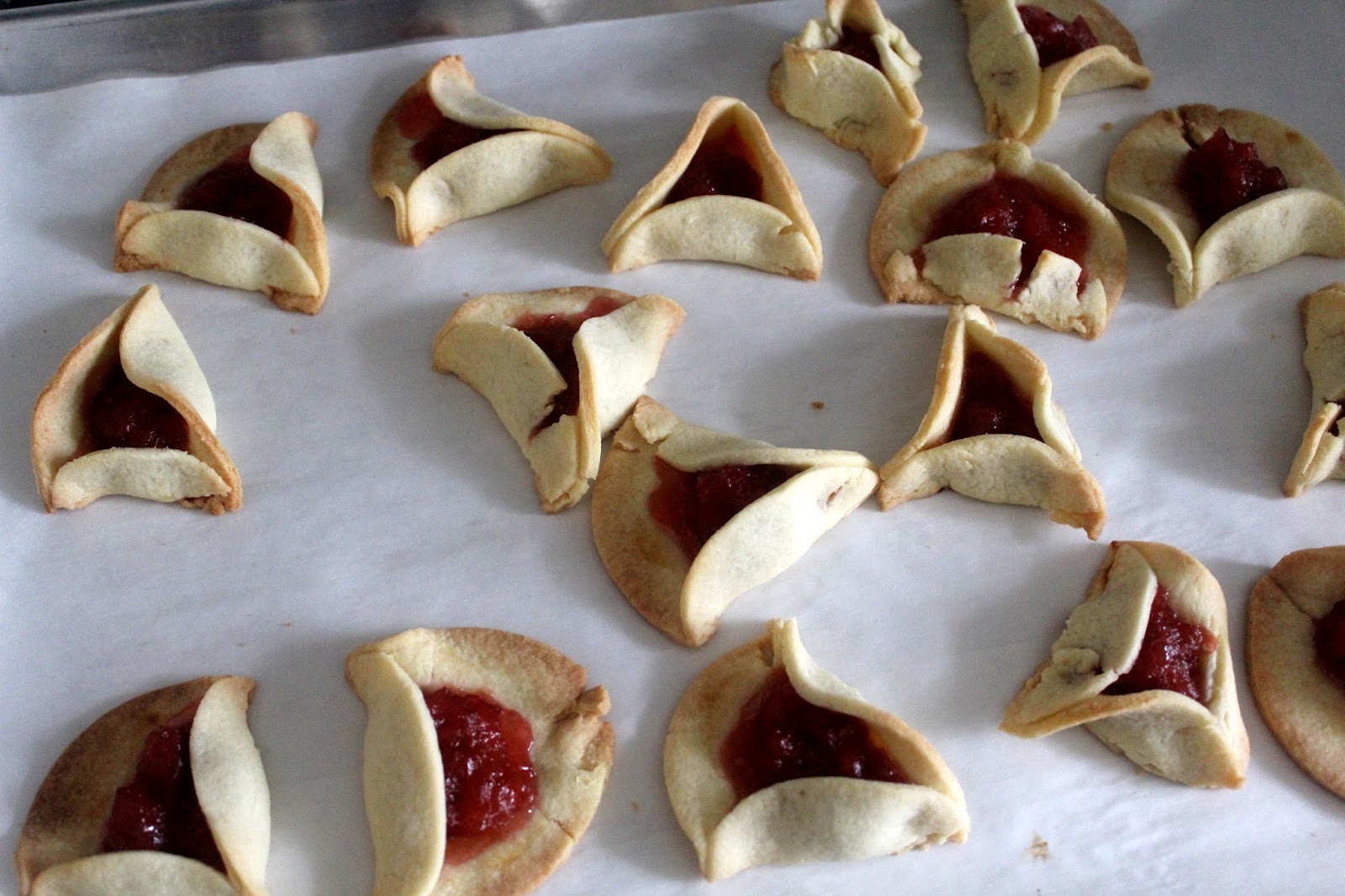
First, I rid my freezer of rhubarb and made her recipe for rhubarb hamantaschen, starting with a simple rhubarb compote.

This is a cookie that's traditionally eaten during the Jewish holiday of Purim. I'm not Jewish, and it's not Purim, but each time I page through the cookbook these catch my eye. They're so pretty, and in the last few years I've become a real fan of jammy cookies.

It was only after I put these in the oven that I learned how difficult it can be to keep the corners together. But I still got a few good triangles, and the taste was what mattered most. If you'd like the recipe, here is one blogger's very enthusiastic transcription of it. 

I didn't let these floppy corners get me down
After a couple of hours, I continued on. Next up in my Smitten Kitchen Saturday was a butternut squash galette.

This tart dough, by comparison, was just as I'd hoped: flaky and melt-in-my-mouth. And it was a dream to work with. I used a combo of white and whole wheat flours, and mixed it with nonfat Greek yogurt and white balsamic vinegar in addition to a stick of butter. The contents included roasted butternut squash, caramelized onions, fontina and fresh thyme (the cookbook calls for thyme, though her original website recipe calls for sage; either would be lovely I'm sure), with just a pinch of cayenne pepper. Pair it with a salad and you really need nothing else for a complete meal.

I only remembered to get a photo of the finished product, right before we sat down to watch The Big Chill (how have I lived my whole life without seeing this movie?!).


I highly recommend this recipe.

I know what you're wondering to yourselves: How does one handle all this butter on a single day? Turns out, you don't need to eat everything in one sitting. You can spread this out over several days or even a week. Enjoy every single bite, savor slowly, and double your normal vegetable intake for awhile. If you feel your conscience try to guilt you about it, be grateful for the very thing that is sitting in front of you on your plate. It's the holidays. This is appropriate.

3.29.2017

Define "snack cake"

I haven't definitively figured out what makes a cake a snack cake, but based on my limited research (which included wading through links for Hostess and Lil Debbie varieties), it seems to be a kind of cake you can pack up and stash somewhere and devour wherever and whenever. So whereas a rich layer cake may be more of an event, a piece of throw-in-the-bag snack cake just makes part of your day better. Whatever it is, or is not, I am generally a fan of packing cake in my lunch to save for my mid-afternoon slump.

So yes, I made a snack cake. This recipe for banana-oat snack cake came to me via Bon Appetit after I found a freezer bag of frozen bananas, a fresh bag of crystallized ginger, and an annoyingly inadequate amount of chocolate chips to do much else with. The recipe doesn't actually call for the ginger or the chocolate, but if I've learned anything in these almost 35 years, it's that ginger and chocolate take banana cakes to the highest dimension of "good" in a banana baked good. So I added them. 

Also, the recipe is written as though you have fresh, perfectly yellow bananas, because you are to chop them, rather than mash. I was working with frozen mush, and it worked just fine in the end. I am sure the texture was altered a bit, but the taste was perfectly banana-y and the cake was moist like banana bread.

Today I packed one up in my lunch and looked forward to a happy moment of afternoon snacking all morning.


2.04.2017

7 links + 1 recipe for the weekend


A collection of things I read this past week that were worthwhile.

1. Looking for a break from the doom and gloom, I googled Positive News and found this delightful publication from the UK.

2. I just wish Carl Sagan was still around to tell me all the answers.

3. The case for living a less structured life. Improvise more!

4. Beautiful: Shadow work is active.

5. I am guilty of #3 during work meetings. Words and phrases to ban from your vocabulary.

6. This sounds about right.

7. My former art professor is currently using his blog to examine our current political climate through art, which is how I came across this link. Amazing how a cardboard box company could employ such an inspiring, daring and controversial method of advertising that is more about the art and a greater message.


From my cookbook archives: "You can serve sunshine - in salad," this Better Homes and Gardens book begins. Published in 1958, it is predictably filled with tragically lit photography of molded gelatin, processed cheese and stuffed orifices.

The actual best part of the book, though, is the section on salad dressings. I made this tangy French dressing to top my usual salad (romaine and chopped veggies) and quite enjoyed it. My favorite method to dress a salad is to place all the vegetables in the bowl, toss with the dressing to marinate until you're ready for dinner, and then add the salad greens and toss (by hand is best). A great trick I learned from Mom.

Tangy French Dressing

2/3 c. salad oil (I used olive oil but a more neutral oil would probably be better)
2/3 c. vinegar (I used apple cider vinegar)
1/3 c. water
2 T. chopped chives or green onion
2 tsp. sugar
1 tsp. paprika
2 tsp. Worcestershire sauce
1/2 tsp. salt
1/2 tsp. celery salt
1/4 tsp. dry mustard
Freshly ground pepper

Whisk together, shake well before using. Serve over greens. Makes 1 3/4 cups.

(And if you want to make scones for breakfast as in the photo above, my favorite recipe is in this post.)


12.18.2016

A Little Christmas Music

Sometime before Thanksgiving I was driving around and listening to classical music on public radio. They started playing a bright, brassy number with fast vibrato – probably something by a British brass band - and all at once, gosh darn it, I felt the spirit of Christmas move in my weary soul. The piece was not a Christmas hymn or anything explicitly written for the holiday, yet I found myself waiting at the traffic light, reflecting on my feelings and letting the music transport me to Christmases past.

My mind took me to when I was about 6 or 7: Pulling peppermints off of the advent calendar hanging on the door in the kitchen; unpacking the odd boxes that held the ornaments; the smell of candles, freshly snuffed; a package of Schwarzbrot from the Timmermann Bakery and rock-hard Haribo gummy bears; and brass music, compliments of my oldest brother, Rich. It was then that it hit me how much that brother was so entwined with my more visceral memories of Christmas.

Rich was about to graduate from high school when I was born, so Christmas and summer - his breaks from college - were really the only times I got to spend any amount of time with him as a kid. I remember feeling shy around him because I had to get reacquainted with him each time, but it helped that he brought me music, books, and once, a pencil case from New York City that was long a prized possession. Our house had a different energy when he was home – my other two siblings were around a bit more, too, along with my Oma, and sometimes my Uncle Art and Aunt Alice. While the house at other times of the year felt more like a kid’s domain (to me, at least), at Christmas, everything suddenly felt that much more adult. And thus I remember trying to act a little more like an adult, too – eating things I didn’t care much for because I knew they were special (like that Schwarzbrot), sitting at the table while the adults conversed, not always knowing what they were talking about but waiting for a moment that I understood or could insert a joke or make a funny face. I remember my brothers watching movies in the family room (Dad usually gave us sets of Laserdiscs for Christmas) while I played with my new toys in the living room, and hearing them laugh heartily. And at some point during his visit, Rich would inevitably turn on a cassette tape that featured one or several of his performances at school. Our parents listened with great interest and pride. I found it rather boring and couldn't wait to put on the fun records again.

One year Rich gave my parents a copy of the King’s Singers “A Little Christmas Music.” Not surprisingly, I didn’t like it one bit the first few times we played it – too stuffy-sounding, sometimes weird, what’s with men singing with high voices, anyway? – but it was on repeat long enough that the next year and in the years that have followed, it doesn’t feel like Christmas without it. Today when I listen to my favorite “Ding dong! Merrily on High” I feel a certain nostalgia toward that punchy brass. Those men in falsetto have even been known to prompt a tear if I'm not on guard. May the music always remind me of the joy of the anticipation of being reunited with family. Christmas is here.

Rich on the left, me with the stuffed animal abundance, Dad on the right

7.25.2015

Saturday Sentimentalist: Things I Learned After Watching "Good News" a Million Times

Beginning in junior high, I developed a love for - nay, an obsession with - a lesser-known 1947 movie musical called Good News. It stars June Allyson and Peter Lawford on the campus of the fictitious Tait College in 1927, a year that many pop culture enthusiasts claim to be one of the best (Bill Bryson wrote a whole book on the marvelous events that happened just during that summer; worth a summer read). It's in Technicolor. There are lively, coordinated dance numbers. Mel Torme's vocals cast a velvety glow on the whole thing.

What I loved about it, especially in my teenage, boyfriendless years, was the portrayal of college, and of how a pretty but humble student librarian could win the heart of the most popular and attractive guy on campus, the star of the football team. I mean, young Peter Lawford, people.

Oh, but I also loved the idea of studying in old brick buildings, living in the grand mansions of sorority life, cheering with the crowd at a football game, and wearing cardigans with pearl buttons just like June Allyson's character, Connie. In my mind, I too could attend such a college, and with a big intellect and small waistline, surely I could just be myself and inadvertently woo a ladies' man to change his ways and devote himself to me. 

While I did go to college and owned two soft cardigans with precious little buttons, and though I lived in a dorm built coincidentally in 1927, in a room that overlooked the cheering crowds at the football field, I graduated without a jock hanging on my arm. By that time, I'd realized that most athletes I'd met weren't usually as eager to nerd out on indie music as I was, which was my primary extracurricular interest and the basis for most of my crushes. Needless to say, Good News was not my college story. But after watching this feel-good musical again recently for the first time in years, it became clear just how many of those things I internalized in some way, whether I intended them to or not. Here are the strange ways this movie has permeated my life:

1. A college campus makes me happy. My whole growing up life, I loved imagining that I was in the midst of a musical. Being on a college campus is the perfect place to feel as though a musical is about to happen, where you have hundreds of characters around you, witness dozens of impromptu interactions on a daily basis, and a beautiful setting for it all to take place. As a student, I loved being able to say that I lived in all of it, and as an employee, I love watching the predictable energy at various points of the year. 

2. Respecting my independent self. What I loved about the character of Connie was that she was a do-it-yourselfer. She could fix a sink, sew a dress, and work her way through college. And she had a healthy amount of pride: When asked to go to the dance by Tommy (Peter Lawford) after he was turned down by his first choice (the evil, gold-digger Patricia McClellan), she resisted because she knew that it would make her "second fiddle." But, of course those P-Law puppy-dog eyes convinced her otherwise. Like Connie, I worked in the library through my college years. I had financial aid and lots of help from my parents, but I also knew I needed to work and get started on my own. And I've also appreciated any chance I've gotten to learn how to do things myself. Because as long as I was single, it was fun to pine, but it wasn't fun to mope. Better to figure out what you really love and enjoy doing, regardless of your relationship status, and develop yourself.

3. Appreciating high brow AND low brow. The closing scene is a shocker when intellectual Connie attends the homecoming dance and leads Tommy and everybody else in the latest dance craze, the Varsity Drag. A delightful surprise to all! And maybe that's why on my Friday commute, I often turn the dial from NPR to the Top 40 station. Because in case people think I'm a total bore with all of my book knowledge, they'll change their mind and nod with approval when I recite all the lines to "Bad Blood" by Taylor Swift. It's about balance.

4. Learning French. Is it just a coincidence that, like the "French Lesson" scene (which, if you watch nothing else of this movie, you must at least watch this much) between Connie and Tommy that launched their romance, one of the first activities Joel and I enjoyed together was learning French?


5. Money can't buy happiness. "The Best Things In Life Are Free" is the anchor theme of this musical, and the song gets sweeter and truer as the years go by. People who chase money, like the aforementioned debutante character Patricia McClellan, are not worth investing your time in. Those who find joy in what's already around them will be set for life. I try to remember this every day.

You want to watch it, don't you?