Showing posts with label Dessert. Show all posts

11.02.2019

Vintage recipe test: Peanut Butter Bread

From my Oma's collection comes my copy of The Settlement Cook Book (the main title is actually The Way to a Man's Heart), given to her on Christmas 1945 from her dear friend Mamie. There were a number of settlement houses in the 19th and 20th centuries, one of the best-known being Chicago's Hull House. The Settlement House of this cookbook was a charitable organization that helped women in need and Jewish immigrants.

The author, Lizzie Black Kander, was a social worker there who was tasked with instructing these women how to be homemakers in America, and this cookbook was her answer. So although it's a cookbook, it's also a manual of sorts instructing women how to set a proper table, drain dishes, polish silver, pick up broken glass, and store milk. I'm sure my edition was updated for a 1945 kitchen, reflecting ingredients and conveniences that arrived after its original publication. Proceeds of the book benefited the house, and it was reportedly the most successful fundraiser of its kind. More than 40 editions have been printed since its first first sold-out printing in 1901, last revised at some point in the 1990s. My copy is the 27th edition.
Opening this book feels like opening a sort of treasure or time capsule. Each delicate page can contain as many as five recipes, sparsely described, often referring to a recipe on another page.  There are no food illustrations - we're used to that with vintage recipes - but there are occasional darling illustrations of children happily doing things: rolling pie dough, fishing, collecting eggs.

My maiden baking voyage from this book was peanut butter bread. As soon as I saw the recipe, I marveled at the fact that peanut butter bread isn't really a thing in modern the quick-bread world, for as much as the modern world loves peanut butter. It's hard to find recipes for it on the internet, where I found it described as Depression-era food.

Other than the peanut butter, there is no fat in this recipe, unless you count the milk (whole milk would have been best, but I only had 1%). I had to make my best guess as to what kind of peanut butter I should use, i.e., was the peanut butter of this era more like Adam's natural peanut butter, the kind you have to stir, or was it common yet to find homogenized peanut butter which is most common today? After some "history of peanut butter" Google searches I felt OK about using the no-stir variety (homogenized was common in the 1930s) from Adam's, which has no sugar.

I also wondered about baking powder, since that has changed with time as well with double-acting varieties being the norm in most kitchens. This recipe called for four teaspoons which seemed like a lot. I used the full four teaspoons and nothing crazy happened.

Making it, it is everything a quick bread should be: it comes together in the time it takes to heat the oven, especially with a Kitchenaid mixer. The batter is like that of bland peanut butter cookie dough. I took the liberty of sprinkling turbinado sugar across the top after pouring it in the pan.

So how did it taste? Fine, not remarkable. Like something you'd serve and eat with other things, but probably not something you'd eat, rave about and ask for the recipe. But it was a little more special than mere sustenance. Mrs. Kander advised waiting a day before eating it, which we did, so we'll never know the difference of tasting it fresh out of the oven. My parents were with us the morning of the inaugural slices, and it was a nice accompaniment with coffee and eggs, topped with salted butter, or strawberry jam, or Nutella, the latter of which I enjoyed that evening for dessert (sliced bananas atop the Nutella would have been even better). After day six, only the heel remained and it was so dried out and crumbly,  it was almost like eating a peanut butter cookie. We still ate it and didn't mind.
Appropriately eaten from one of Oma's plates

I don't need to make it again, though it was enjoyable to eat. As Mamie wished for my Oma in her inscription, I'd consider this experience a happy recipe try-out.

Try it for yourself, and maybe add in some chocolate chips, or cinnamon, or both. Or make a yummy glaze: chocolate, strawberry or simple sugar.

Peanut Butter Bread
adapted from The Settlement Cook Book

2 c. flour
4 tsp. baking powder
1 tsp. salt
1/4 c. sugar
2/3 c. peanut butter (I used Adam's No-Stir crunchy)
1 1/4 c. whole milk
2 T. turbinado sugar, for topping

Grease a standard loaf pan well with shortening, butter, or other greasy thing of your choice. Heat the oven to 350 degrees.

In the bowl of your mixer, sift together the dry ingredients. Add the peanut butter and milk and beat at low speed to prevent milk splashing, then increase to medium speed until thoroughly mixed. Pour into the loaf pan, sprinkle with the turbinado sugar, and bake 45-50 minutes, or until the bread is golden and a toothpick comes out clean-ish (a few moist crumbs are okay). Let the bread cool in the pan for a few minutes on a cooling rack, then turn out of the pan to cool completely.

Eat it the first day. I dare you. Or follow Mrs. Kander's suggestion and eat it a day later.

10.14.2019

Vintage recipe test: Good Neighbor Cake


This recipe comes to you from Cooking Bold and Fearless, a 1957 Sunset Magazine publication that features recipes from "Chefs-of-the-West," predominantly male, as far as I can tell.


The Good Neighbor Cake recipe is signed by Fred Nehsmann, a writer in Lemon Grove, Calif. I tried looking him up on the internet to no avail, so I'm not sure of his credentials and why he was deemed worthy of inclusion in the "Chefs-of-the-West" group. 

A neighborhood block party provided the perfect occasion to try this out. I know it's never a good idea to test out a new recipe on guests or party-goers, but I put a lot of faith in the title. I've always loved the idea of baking something to take to a neighbor, but have been too shy to do so, so a block party provided a way to quietly set something on a table and let people try it, no pressure. I also loved the seasonal ingredient of apple at an October gathering.


The Good Neighbor Cake a basic layer cake with orange zest, and the frosting is made with egg whites and sugar, studded with apple. Otherwise, nothing terribly fancy.


While it turned out fine, a few modifications along the way probably made it better than as written, and had I been more of an expert in making layer cakes, I probably would have realized sooner that caster sugar is better for cakes and frosting, and that I overwhipped my egg whites for the batter. 


The cakes also sunk quite a bit, and I wonder if that was because of the egg whites, or because I forgot to turn on the oven ahead of time, so the pans with the batter were sitting out longer before going in the oven.


The simple frosting called for freshly grated apple, and I worried that the apple would cause the mixture to separate due to wetness, or make the cake soggy. I elected to squeeze out as much juice as possible before adding it to the frosting, and while it was still kind of a sloppy frosting, it held up okay on a cool evening (the juice was also very tasty on its own!). But I wish I'd used powdered sugar because you could feel the grit on your teeth.

Also, how do we feel about eating uncooked egg whites? I'm OK with it, but it's one of those things I probably wouldn't tell people before they eat it... that's the kind of Good Neighbor I am.


Here's the original recipe:


And my version:

Good Neighbor Cake
Adapted from Cooking Bold and Fearless

Ingredients
1/2 c. butter, room temperature
1 1/2 c. sugar
Zest of one large orange
4 eggs
2 c. sifted cake flour (i.e., sift the flour before you measure it)
4 tsp. baking powder
1/4 tsp. salt
1 c. whole milk

For frosting:
One Granny Smith apple
1 c. powdered sugar or fine/caster sugar (or just blitz regular sugar in the food processor for a few seconds)
2 of the egg whites from the four eggs above

Make the cake
1. Heat the oven to 350. Grease and flour two cake pans.

2. Separate the eggs: using three bowls, place all four yolks in one bowl, and two egg whites in another, and the remaining two in the third bowl (this will be used for the frosting - place these in the fridge until needed). 

3. Sift the flour with the baking powder and salt and set aside.

4. Cream butter and sugar together until light, about 5 minutes on medium speed. Add the orange zest.

5. Beat in egg yolks, one at a time, mixing thoroughly after each addition, scraping down the bowl as necessary. 

6. Alternate adding portions of the flour mixture with the milk, beating until smooth, several rounds. 

7. In a separate bowl, beat the two egg whites until stiff peaks form, but not dry (I overbeat these, I think, which might have caused my cakes to sink). Fold gently into batter until there are no white streaks.

8. Pour batter evenly between the prepared cake pans. Bake 25-30 minutes, until tops are springy and lightly browned. Remove from pans and completely cool on a rack.

Make frosting

1. Peel and grate the apple.

2. Beat the remaining 2 egg whites until stiff, then gradually beat in a cup of powdered sugar (I used regular sugar but found the texture rather grainy; I think powdered or at least caster sugar would have worked out better).

3. Squeeze excess juice from the apple and beat into the frosting. Frost the cooled cakes and layer together. Keep cool in the fridge until serving.


8.08.2019

From the summer kitchen

With the deck project having taken away crucial barbecuing space this summer, and with the milder temperatures not preventing me from turning on the oven, it's been a slightly different kind of summer table spread. Here are the things I remembered to document:

For breakfast...


Dutch babies. I experimented with a couple different recipes, including a gluten-free variety, to get the perfect baby for all. These were a special request for Joel's dad's birthday breakfast.  Pictured here was the first try, and my favorite basic recipe from a 1974 Scandinavian cookbook from Sunset magazine (thanks, Mom!), baked in a cake pan. It has a little lemon zest and cardamom in the batter, which is simply nice. I mean, it's really hard to screw these up. But they always feel special.


Buttermilk sandwich bread...which I used for croque madames...in honor of the final stage of the Tour de France, which as I might have mentioned before, I won. 


Blueberry scones. Made on a slightly hungover Sunday morning after a night out with my gal pals, who sent me home on my bike with a pint of freshly picked blueberries in my pannier. I used a recipe for whole-wheat buttermilk scones that called for raisins, which I subbed with the berries. The scones were a tad dry (whole wheat flour AND oatmeal) so the berries added a nice burst of juice and flavor.


Baked banana buttermilk donuts. My local kitchen supply store had a sale during the 4th of July on all products that were made in the U.S.A., which included a donut pan I've lusted after for years, so I took it as a sign and bought it. Thanks, America. Because I had buttermilk and overripe bananas, I looked online to see how to combine it into donuts. We topped these with Nutella. It tasted more like a muffin. But donut shaped.

(If you can't tell, I seem to have a lot of buttermilk to deal with.)

For dinner:


Roasted dill salmon. Dill doesn't often get its day in our house, but I had a real craving for it and this recipe from the New York Times was quick and delicious. You simply make a marinade of 1/4 c. lime juice, 2 T. olive oil, 2 T. soy sauce, 2 T. maple syrup, 3 T. chopped fresh dill, 1/4 tsp. turmeric and a pinch of saffron (if you have it - I didn't), and a crushed garlic clove. Place salmon fillets skin side down on a lined rimmed baking sheet (smaller is better), season with salt and pepper, and pour the marinade over and let it sit for about 15 minutes as the oven heats to 425. Then transfer it to the oven for about 10 minutes and serve with rice or whatever. 


Sesame soba noodle salad with roasted mushrooms and tofu. It's probably one of my favorite meals and I don't make it often enough. It's so savory, crunchy (that's cucumber in there...not avocado) and satisfying and I'm always glad to have leftovers for lunch. The recipe comes from Melissa Clark's Cook This Now...like so many recipes I post on this blog.


Soupe au pistou. I held onto this recipe from my Milk Street mag a couple months back for pesto season. It's weird because you'd think the last thing you'd want to make in summer is soup, but this celebrates all its flavors and it was so, so good. Fresh tomatoes, green beans, carrots, beans, garlic and small pasta go into the soup, and the pesto is added as a garnish. It's nice to have a partner who works from home and can prep this on a weekday afternoon and tend to it as needed (cooked from dried beans), otherwise this would have definitely been a weekend meal. 


Chicken Milanese with tomato, mozzarella and basil salad. Because after a long day, it feels good to take a meat pounder to some chicken cutlets. The basil dressing that goes with this is divine. Another gift from Melissa Clark via the New York Times.

Chicken tinga tacos. This is something Joel makes and it's one of my forever favorites. I don't care about other recipes for chicken tacos or burritos anymore. I contribute the pickled onions and a side of Rancho Gordo beans. 

For dessert:


Smoked paprika peanut butter cookies. I got the recipe from David Lebovitz's blog and was totally starstruck (in the nerdiest of ways) when he shared my post on Instagram and used it as an opportunity to link to the recipe again. To be honest, I was expecting more smoke, but ultimately these were just strangely colored but very delicious, chewy peanut butter cookies. 


S'mores blondies. If these aren't viral on the internet yet, they will be. Gooey as all get-out. I took to calling them power bars. 

1.26.2019

Recipe test: Lucky Charm Brownies

My house is loaded with chocolate right now. After Christmas, our junk pail (an old metal "Gremlins" lunchbox where we stash packaged sweets) is filled with the stuff, and I'm waiting for just the right moments to partake, as long as I don't forget about them. I enjoy chocolate, but I'm not one to crave it. If different varieties of desserts are covering a table (what a fantasy), I will almost assuredly opt for the non-chocolate options.

But what care you, the rest of the world, who will gladly eat the portions I don't? Through my baking with Dorie Greenspan's recipes, I am learning she has a strong fondness for it. Without investigation to back up my estimations, I'd say that at least 50 percent of the recipes in Dorie's Cookies contain chocolate, 40 percent feature it prominently, and there are at least four recipes for brownies.

Here's one of them.

Despite the name Lucky Charm Brownies, they contain no trace of dried technicolor marshmallow or crystallized wheat cereal. They do, however, contain amaretti, those delightfully airy, easily poppable almond meringue cookies you might find on the saucer with your espresso.

This recipe could be gluten-free if the amaretti were...I think the traditional ones made by Lazzaroni are, but whatever off-brand variety Rosauers carried added wheat.

Regardless, the taste of amaretto comes through beautifully, and the amaretti-sprinkled glaze makes these brownies more like a decorated and decadent flourless chocolate cake. I suppose I could have simply baked this in a round cake pan and no one would have been the wiser.

I cut 1-inch squares and call them truffles. Because, sorry Dorie, these are not brownies. I've kept them in the fridge, at her recommendation, and cut the squares as I need them. We left half the slab with friends last weekend, and one week later, there's exactly one square left for someone in this house. Slow to disappear, long to savor.

The recipe is posted here on Food52.

A couple notes from my experience:

1. If you have a kitchen scale, definitely use it to weigh the ingredients. The amaretti I found were much lighter or smaller than the ones she described, so I had to use more cookies. I weighed the almonds and chocolate, too. This is my key to success when baking.

2. I used dark chocolate (72%) because I couldn't find bittersweet. Still had a nice, slightly bitter flavor, and maybe a little less sweet.

10.20.2018

Recipe test: Cinnamon surprise


Every fall I get the bread-baking itch. Actually, that's not true. I always want to bake bread, but in the fall, the kitchen gets cold and drafty, so I'll turn on the oven as much as possible. The smell of bread also makes things feel warmer, even if it isn't. A couple weeks ago I checked out Rose Levy Beranbaum's The Bread Bible from the library in an attempt to up my game. Beranbaum takes title seriously as she includes ratios that should be learned and understood by the most earnest bakers, and lays out step-by-step instructions including how many hours and days to plan out each recipe, which I appreciate. She is also specific on flour brands - King Arthur is indeed king in many of these recipes. She seems worthy of my trust for all the trial and error, the mathematical equations, and variations featured with each recipe.

I mean - I suppose I could become a home baking expert someday, especially if I studied this book. But the longer I live and the more time I spend in the kitchen, the more I don't want to be an expert. I just want to wield my trusty kitchen utensils and equipment and turn out something decent and be delightfully surprised by the results. Something I'm learning about myself is that I need a healthy balance of understanding why things work while leaving room for the magical, nostalgic and even therapeutic moments that make me love baking in the first place.

I'm also finding that the best bakers of bread are patient people, as noted above. And because most of my baking is done on the weekend, the thought of having to start something on a Friday (good luck to me, who is more apt to pour wine on a Friday than weigh flour), tend to it on Saturday and finish it on Sunday, or later, is a surefire way for me to lose steam. So as I paged through this bible, I fell into my usual trap of identifying the easiest looking, least time consuming recipe to try first.

Enter: Cinnamon crumb surprise. No yeast! A couple hours required! Moist crumb, warm spices! And, a surprise!

The recipe checked all the boxes for me. It was fairly easy but still taught me something - in this case, that it is important to use either cake flour or a bleached all-purpose flour to keep the butter suspended in the batter. Otherwise, the surprise, i.e., sliced apples throughout the middle, may sink. And the magic: I fully expected it to completely fall apart when I took it out of the pan, but I managed to keep it in one piece, and it sliced up beautifully. It tasted like all the flavors you want in the fall.

Though it should come as no surprise at all - this is not bread. It's cake.

Perhaps I'll make bread next.

The recipe is posted here, if you're interested in checking it out.


11.21.2017

Buttery weekend

Last weekend we were at Auntie's Bookstore and I got that familiar feeling of being overwhelmed by the number of books I will never read. Or the cookbooks I will never cook from.

But worse, holy lords!, my conscience nags, think of all the books that are just sitting on my shelves at home right now, books that are half-read, cookbooks that are barely weathered.

Rather than buying anything new, I returned home and hung out with my books. It's a weird combo of feeling a little depressed and a little grateful. Look at all I don't have. Look at all I do have. Hey, it's the holidays. This feels appropriate.

Rhubarb compote
Also appropriate in this moment: butter-laden recipes. In November and December, butter is cheap, and there are likely things sitting in your freezer or on your counter that could easily be transformed into a sweet or savory filling in a buttery tart dough.

So in the spirit of appreciating what I already have, in one Saturday, I used one well-loved cookbook and one pound of butter to do just that - dinner (big savory tart) and dessert (sweet mini tarts). The cookbook was Deb Perelman's The Smitten Kitchen Cookbook. It's been awhile since I've tried anything new out of it.  (And I've since been tempted to buy her brand new cookbook.) Trying new recipes gives new life to older cookbooks, and until Saturday, this one's pages were mostly well-worn in the pizza dough section (I've since memorized her recipes for pizza sauce and rushed pizza dough).

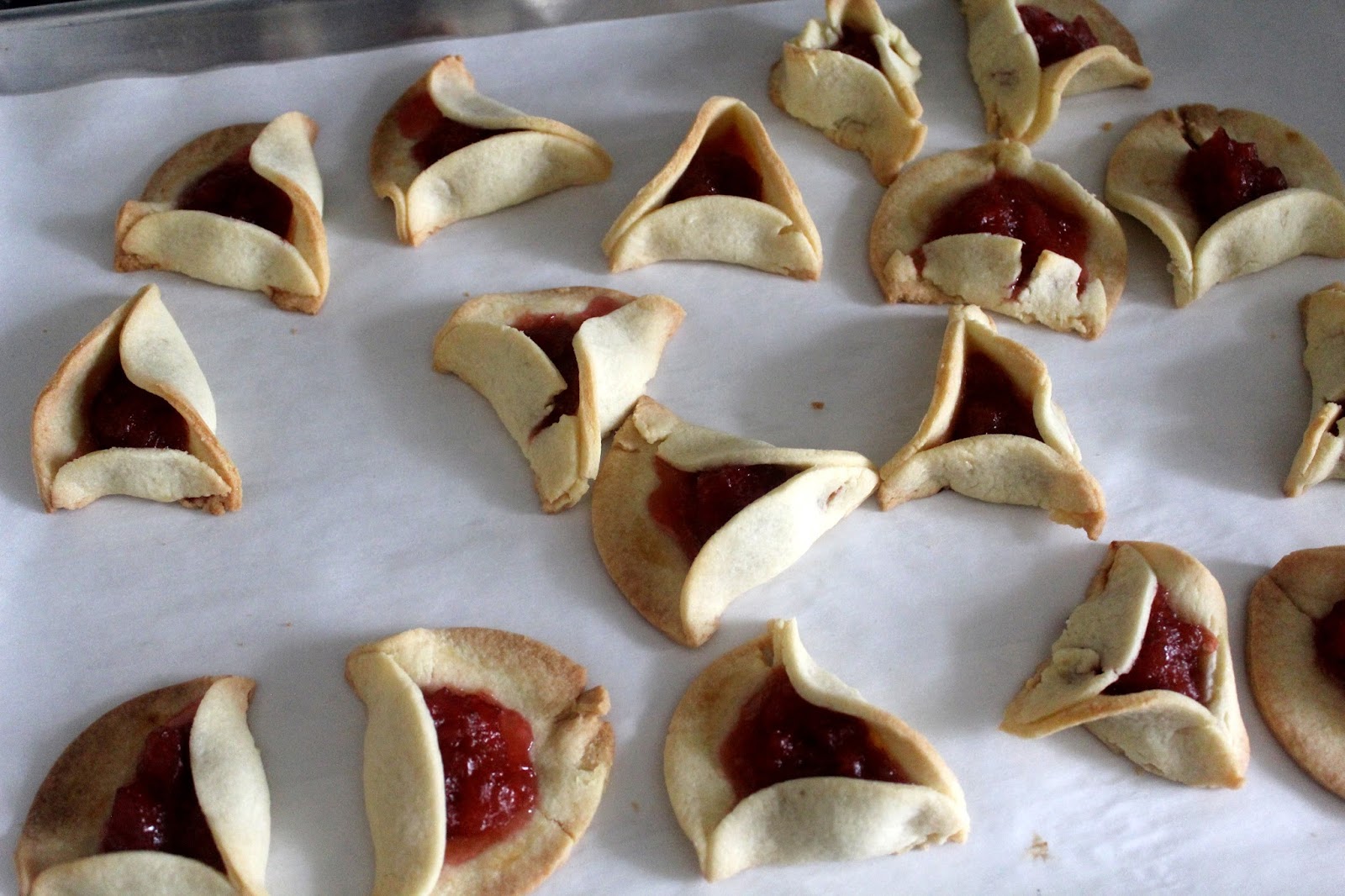
First, I rid my freezer of rhubarb and made her recipe for rhubarb hamantaschen, starting with a simple rhubarb compote.

This is a cookie that's traditionally eaten during the Jewish holiday of Purim. I'm not Jewish, and it's not Purim, but each time I page through the cookbook these catch my eye. They're so pretty, and in the last few years I've become a real fan of jammy cookies.

It was only after I put these in the oven that I learned how difficult it can be to keep the corners together. But I still got a few good triangles, and the taste was what mattered most. If you'd like the recipe, here is one blogger's very enthusiastic transcription of it. 

I didn't let these floppy corners get me down
After a couple of hours, I continued on. Next up in my Smitten Kitchen Saturday was a butternut squash galette.

This tart dough, by comparison, was just as I'd hoped: flaky and melt-in-my-mouth. And it was a dream to work with. I used a combo of white and whole wheat flours, and mixed it with nonfat Greek yogurt and white balsamic vinegar in addition to a stick of butter. The contents included roasted butternut squash, caramelized onions, fontina and fresh thyme (the cookbook calls for thyme, though her original website recipe calls for sage; either would be lovely I'm sure), with just a pinch of cayenne pepper. Pair it with a salad and you really need nothing else for a complete meal.

I only remembered to get a photo of the finished product, right before we sat down to watch The Big Chill (how have I lived my whole life without seeing this movie?!).


I highly recommend this recipe.

I know what you're wondering to yourselves: How does one handle all this butter on a single day? Turns out, you don't need to eat everything in one sitting. You can spread this out over several days or even a week. Enjoy every single bite, savor slowly, and double your normal vegetable intake for awhile. If you feel your conscience try to guilt you about it, be grateful for the very thing that is sitting in front of you on your plate. It's the holidays. This is appropriate.

8.04.2017

Recipe test: Adventures in vegan dessert

I take issue with vegan recipes that are labeled with non-vegan terminology. So when a vegan recipe is called "lime cheesecake," if I make it, I'm going to call it what it is: Lime-Avocado-Coconut-Cashew Icebox Dessert.

Do you still want to eat it?


I made it this weekend.

The inspiration to make it came from my weekly Splendid Table email, which featured a review of the new Vegan: The Cookbook by Jean-Christian Jury. The picture of the so-called cheesecake wowed me with its bright green color flecked with darker shades of lime zest. Marble-counter backdrops also suck me into recipes. They make pretty much any food look good. In any case, I had a number of ingredients in my pantry (dates, coconuts, raw cashews) that needed to be used up, and I loved that I didn't need to turn on the oven at all, so I scheduled this into my Sunday.

This is a raw dessert. The things that hold it together and give it bulk are presumably healthy fats and oils, i.e., cashews, coconut oil, avocado; plus some healthy-seeming sugar sources, like maple syrup and dates. It's very trendy, and the ingredients don't come cheap. Even shopping at Trader Joe's, you will spend $16 on the two bags of raw cashews alone. I had to go elsewhere for the cacao nibs, which set me back another $6. This is not a sustainable lifestyle for me.

For a one-off, though, it was fun to try as I attempt to add to my repertoire of recipes to satisfy a variety of eaters. And I should say that if a show created by Lynne Rosetto Kasper, i.e., The Splendid Table, publicizes a recipe, I give it the benefit of all doubt, so I soldiered on despite any skepticism.


All in all, it was quite simple to make. I'd made a similar sort of crust for Thanksgiving a couple years ago for a vegan pumpkin pie. Dates and coconut pair well with warm spices, so I was curious how it would fare with a tangier topping. When it came to making the topping though, it seemed to be missing that vibrant green color (I was likely fooled by color correction) and the bright citrus flavor. I blame the avocado for both of these things. I froze it and later placed it in the fridge, as specified, and when it came time to cut into it, it looked even less appealing. You could see all the grainy cashew bits and it didn't look super creamy. Maybe that's just under-processing on my part. When I went in for that first bite, I was even more glad I refused to call it a cheesecake. And it most definitely needed more lime. But it wasn't bad.

I saved us a small portion to keep in the fridge and I took the rest to work. I told my coworkers what it was (not a cheesecake), sent them the link, and to my astonishment, people were actually liking it. They probably didn't love it, but everyone I talked to seemed a little surprised they liked it. One of my coworkers who is into the raw/vegan diet gave me two thumbs up. Another forwarded the recipe to a friend she knew would love it. And another thanked me for not calling it cheesecake ("It was better knowing what I was eating," she said. Exactly.)


I probably won't make this again, but it was fun to try. Let me know if you make it or if you have a favorite nutcake-disguised-as-cheesecake recipe.

Here's the link to the recipe: Lime Cheesecake


3.29.2017

Define "snack cake"

I haven't definitively figured out what makes a cake a snack cake, but based on my limited research (which included wading through links for Hostess and Lil Debbie varieties), it seems to be a kind of cake you can pack up and stash somewhere and devour wherever and whenever. So whereas a rich layer cake may be more of an event, a piece of throw-in-the-bag snack cake just makes part of your day better. Whatever it is, or is not, I am generally a fan of packing cake in my lunch to save for my mid-afternoon slump.

So yes, I made a snack cake. This recipe for banana-oat snack cake came to me via Bon Appetit after I found a freezer bag of frozen bananas, a fresh bag of crystallized ginger, and an annoyingly inadequate amount of chocolate chips to do much else with. The recipe doesn't actually call for the ginger or the chocolate, but if I've learned anything in these almost 35 years, it's that ginger and chocolate take banana cakes to the highest dimension of "good" in a banana baked good. So I added them. 

Also, the recipe is written as though you have fresh, perfectly yellow bananas, because you are to chop them, rather than mash. I was working with frozen mush, and it worked just fine in the end. I am sure the texture was altered a bit, but the taste was perfectly banana-y and the cake was moist like banana bread.

Today I packed one up in my lunch and looked forward to a happy moment of afternoon snacking all morning.


2.10.2017

Recipe Test: Absinthe Cake

David Lebovitz is one of my favorite original food bloggers. Many of the recipes he posts have some charming tidbit about life in France, the people he encounters, the restaurants and cafe culture, and the funny things he's learned through missteps and language fails, both confirming and debunking various stereotypes we have about the French. This is all distilled into his book The Sweet Life in Paris. I bought it before my first trip to Paris as a culture guide as much as a treasure trove of recipes.

I'd kind of forgotten I had it until a recent bookshelf purge. As often happens when I flip through these kinds of books, I'm reminded of why I have it in the first place because my brain lights up with all the possibilities of things I could and should make. The absinthe cake was the first thing I wanted to try, if only because it required a trip to Total Wine where we like to ogle at all the specialty liqueurs that we will never buy.

In fact, we didn't even buy the absinthe, because when it comes to anise-flavored liqueur, we enjoy a cheaper variety of pastis called Prado...so we bought that instead. So, I should confess at the outset, this is not actually an absinthe cake, but a pastis cake. Nevertheless, it's seriously boozy and covered in a sugary crust, brightened with orange zest, studded with crushed anise seeds and utterly decadent for something that looks so plain. (BTW, if you don't like licorice or anise flavors, don't make this cake. Not a problem at this house.)


Gâteau a L'Absinthe (ou Gâteau au Pastis!)
adapted from David Lebovitz

-Makes one 9-inch loaf cake-

For cake:
3/4 tsp. anise seeds, crushed with mortar/pestle or hammered in a Ziploc
1 1/4 c. all-purpose flour
1/2 c. almond flour
2 tsps. baking powder
1/4 tsp. salt
1/2 c. butter, at room temperature
1 c. sugar
2 large eggs, at room temp
1/4 c. whole milk, not super cold
1/4 c. booze (absinthe or pastis)
Zest of one orange

For glaze:
3 T. sugar
1/4 c. booze (absinthe or pastis)

1. Preheat oven to 375 degrees F. Butter a 9-inch loaf pan, lining the bottom with parchment paper.

2. Whisk together the crushed anise seeds with the flours, baking powder and salt.

3. Cream butter and sugar together in an electric mixer for a few minutes, until light and fluffy. Add eggs one at a time, fully incorporating after each addition.

4. Combine the milk and the booze, along with the orange zest.

5. Stir half the dry ingredients into the butter mixture, then add the milk and booze. With the mixer on low, stir the remaining dry ingredients until just incorporated.

6. Pour the batter into the prepared pan and bake for 45-50 minutes, or until a toothpick inserted into the center emerges clean.

7. Remove cake from the oven and let cool in the pan for 30 minutes.

8. With a long toothpick or skewer, poke 50 holes into the cake. Combine sugar and booze for the glaze in a small bowl, but don't let the sugar dissolve.

9. Remove cake from the pan and set it on a cooling rack over a baking sheet. Baste the cake with the glaze on the top and sides until the glaze is all used up.


2.03.2017

Morsels

Happy February! I always rejoice inside when the calendar flips to this short month. It's Friday morning and the snow just started. By Sunday it should be rainy. Other things the weekend brings: a visit from Joel's sister, drinks with my girlfriends (in lieu of the Super Bowl), and baking something for breakfast.  

This week, at long last, I made Dorie Greenspan's World Peace cookies. Even she admits that they're not consistent in the way they turn out - I was expecting them to be a bit bigger - but the taste is tremendous. They're my least favorite type of cookie to make, the kind where you must smoosh a very crumbly dough into a log, chill, and then hope it doesn't all fall apart when you slice them for baking. In this case it was worth the effort.

My challenge this week was to take a CreativeBug class. I don't feel like I really fulfilled it, but it did get me to do some pencil drawing throughout the week. It made me look at objects differently as I considered how to draw them. I'm still lousy at it, but I enjoyed it.


Joel took this one and I like it. This is a corner of our kitchen counter that tends to be dramatically lit this time of year around 3:30 p.m. 


The campus coffee shop on the last day of Jan Term.

Greenhouses. Nice to know something's growing down there.

The campus dining hall in early-morning glory. I've been really grateful for the sun this week.


Poor bike.


I tried a new recipe for Sticky Malaysian Chicken with Pineapple Salad on Wednesday. Fun, cheap and easy!

This one just 'cause her birthday is next week. Photo taken last week before she headed back to Boise.